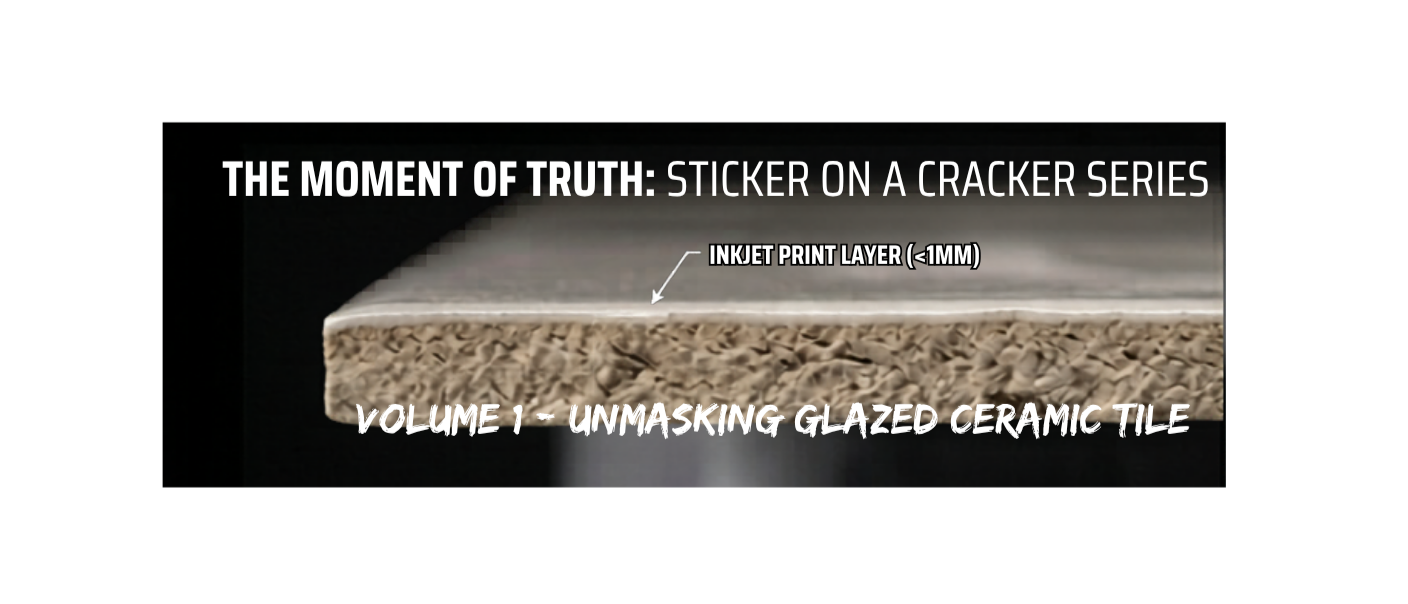
Sticker on a Cracker Series | Volume 1: Unmasking Glazed Ceramic
In the world of high-end design, the word "luxury" has been hollowed out by marketing departments. At The Material Realist, we don't look at the showroom lighting or the lifestyle photography; we look at the physics. Today, we are dissecting the industry’s most profitable deception: the Low-Density Glazed Ceramic Tile—or what we call the "Sticker on a Cracker".
In the world of high-end design, the word "luxury" has been hollowed out by marketing departments. At The Material Realist, we don't look at the showroom lighting or the lifestyle photography; we look at the physics. Today, we are dissecting the industry’s most profitable deception: the Low-Density Glazed Ceramic Tile—or what we call the "Sticker on a Cracker".
1. The Anatomy of a Fraud: The 1mm Veneer
Most "luxury" tiles found in big-box stores are not stone; they are high-definition lies. When you look at a cross-section of budget-grade ceramic, the "marble" or "travertine" beauty is only skin-deep—typically a 0.5mm to 1mm layer of inkjet-printed glaze sitting atop a thick, dusty core.
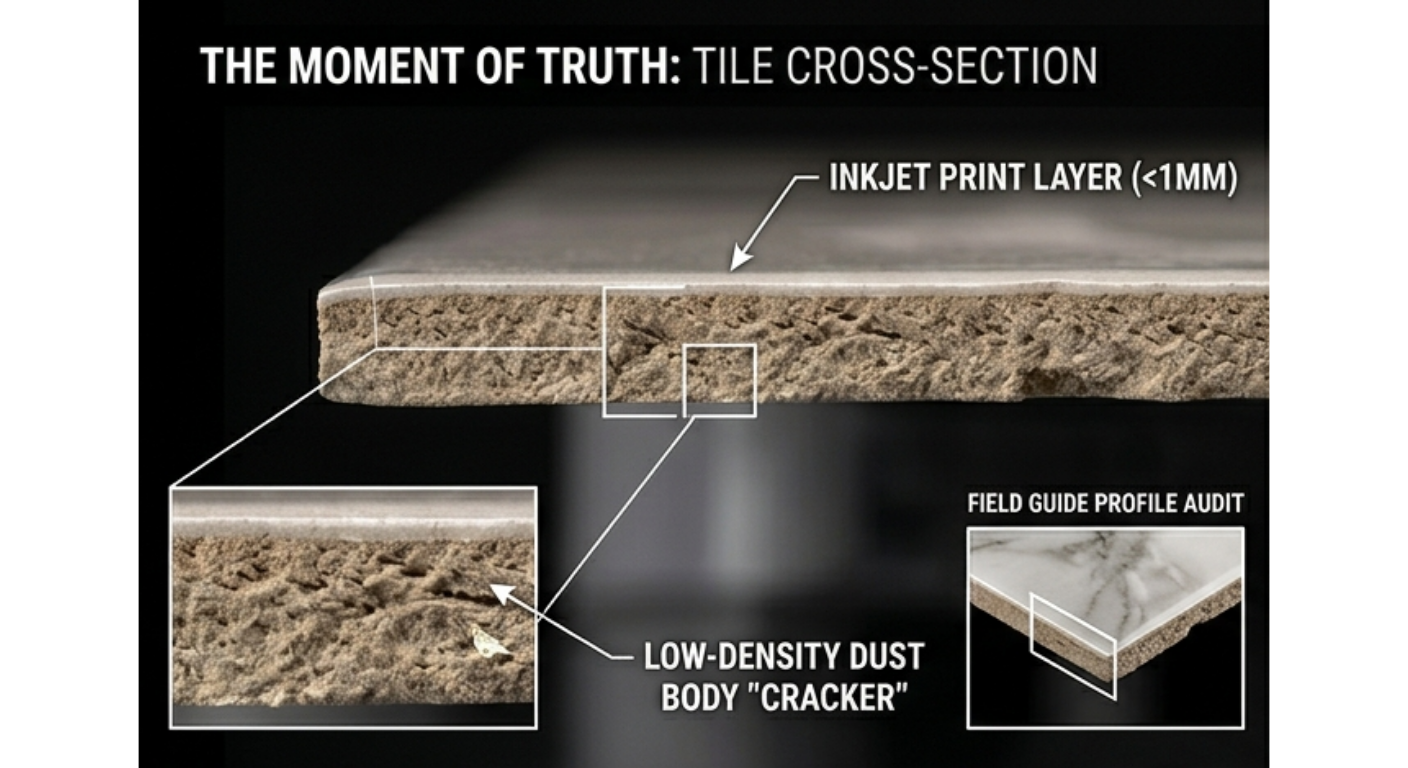
The Sticker: A digital file of real Italian marble is "inkjet" printed onto the surface.
The Cracker: The body is composed of low-density, porous clay—essentially a "biscuit" fired at temperatures below 1,000°C.
The Realist’s Rule: If the beauty of your floor can be scratched off with a screwdriver, it isn’t luxury. It’s a temporary decoration.
2. The Physics of Failure: Why It’s a "Financial Trap"
The difference between a "deal" and a "durable material" comes down to a scientific process called Vitrification. High-performance Italian porcelain is fired at over 1,200°C (2,200°F) until its molecules literally fuse into a non-porous, glass-like state.
Low-end glazed ceramic never reaches this state. This results in two critical failure points:
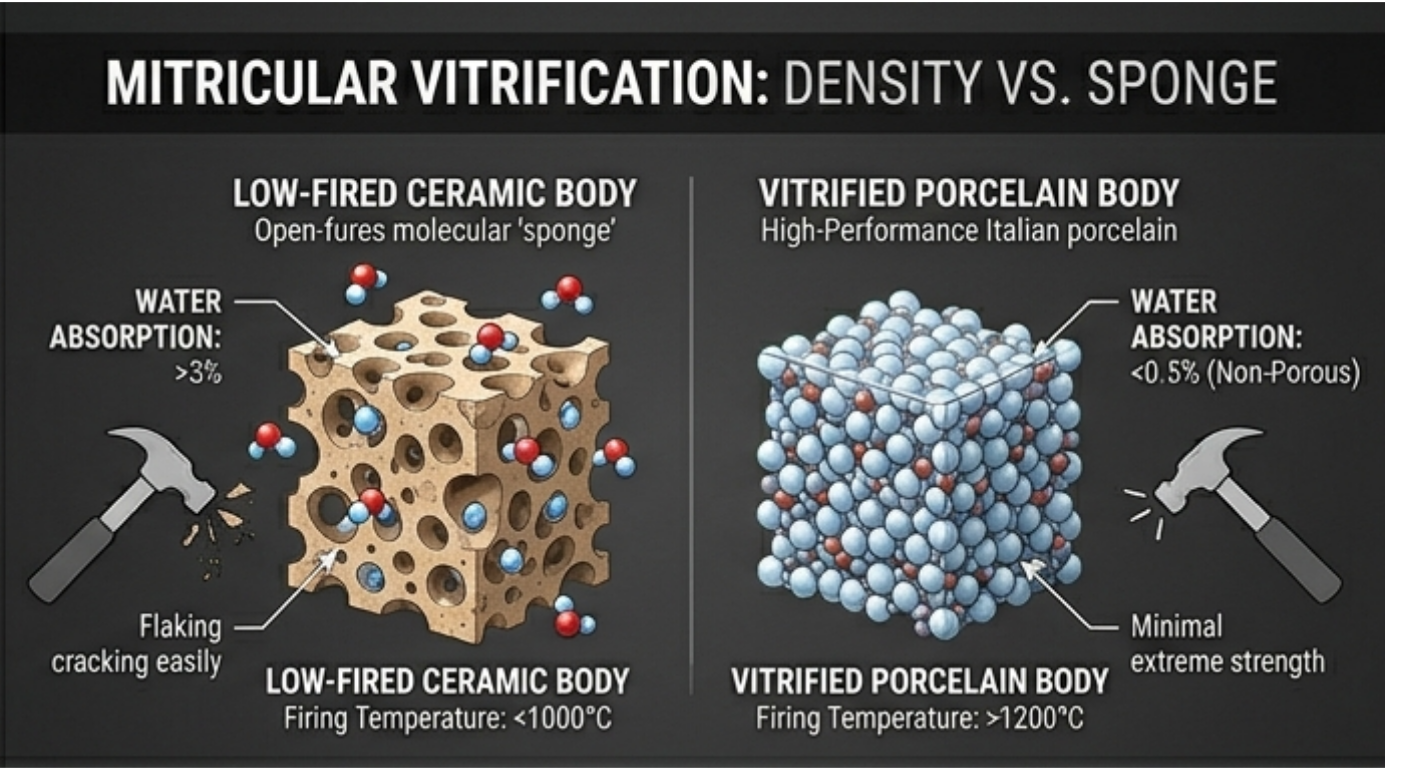
Molecular Porosity: Because the clay isn't vitrified, it remains a "sponge" with water absorption rates significantly greater than 0.5%.
Delamination: In a destruction test, when a heavy object hits the surface, the glaze doesn't just crack; it delaminates, flaking off the clay body and leaving a permanent, ugly scar.
Contrast this with a vitrified product, which is essentially a 100-year material with an abrasion resistance (PEI) rating that handles decades of high-traffic wear.
3. The Showroom "Glitch": Face Counts and Pixel Test
Real natural stone has infinite variation. Cheap tile has a "Face Count"—the number of unique digital files used before the pattern repeats.
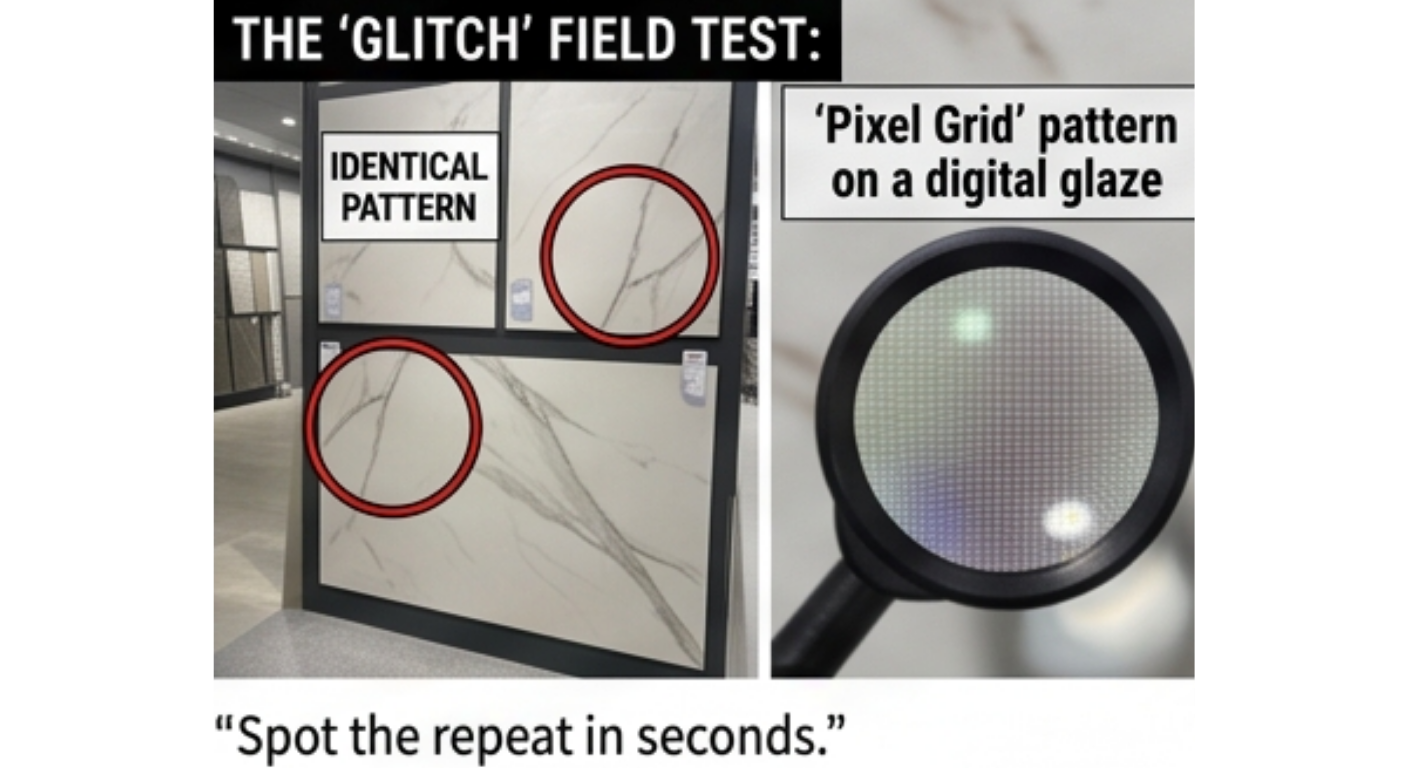
The Fake: Often only 1 to 4 faces. You will see the exact same "vein" or "crack" every three feet on your floor.
The Real: High-end engineering allows for 20 to 100+ unique faces, ensuring a natural entropy that mimics nature rather than a predictable photocopy.
The "Glitch" Test: Next time you’re in a showroom, don’t look at one tile. Look at the whole rack. If you see the same "swirl" twice, you’ve found the limit of the manufacturer's machinery.
The Realist’s Verdict
Buying "Sticker-on-a-Cracker" ceramic is a $10,000 mistake. While the material cost is low, the labor to install it remains the same. When that brittle clay shatters five years from now, you aren't just paying for new tile—you’re paying for the demolition and the re-installation of the truth you should have bought the first time.
Stop buying marketing. Start buying engineering.
Next Installment: The Sassuolo Monopoly: Why the Best Engineering is Concentrated in One Italian Region.
Register for free to download exclusive field guides and member only resources in The Vault.