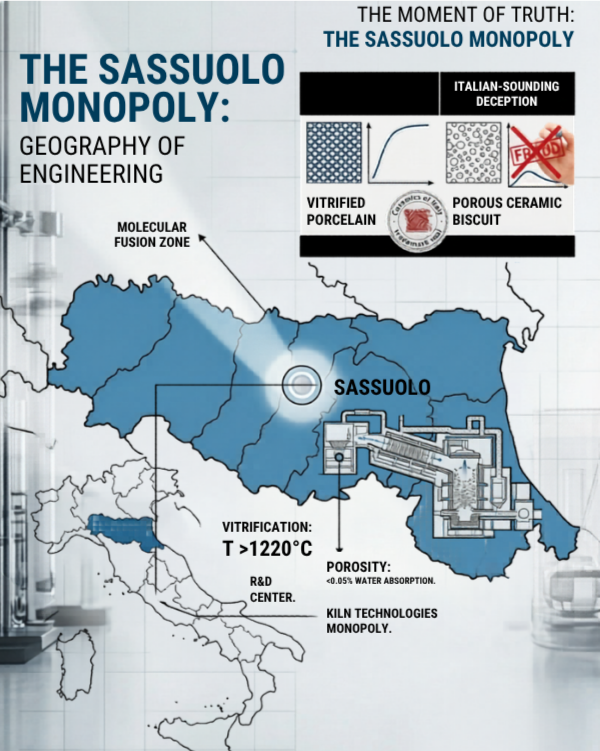
The Sassuolo Monopoly | The Geography of Engineering
In the luxury world, "Made in Italy" is often treated as a lifestyle choice. But for The Material Realist, Italy isn't a destination; it’s a laboratory. Specifically, a 10-mile radius in Northern Italy called Sassuolo.
In the luxury world, "Made in Italy" is often treated as a lifestyle choice. But for The Material Realist, Italy isn't a destination; it’s a laboratory. Specifically, a 10-mile radius in Northern Italy called Sassuolo.
Today, we are exposing the industrial monopoly that defines global quality and teaching you how to spot the "Italian-Sounding" brands designed to deceive your budget.
1. The 10-Mile Brain Trust: Why Sassuolo?
Imagine if every elite silicon chip engineer, software architect, and hardware designer in the world lived in the same tiny town. That is Sassuolo for porcelain tile.
Since the late 1940s, this region has held a monopoly on Material Physics. It isn't just about the clay; it’s about the Machinery (SACMI) and the Chemistry (Colorobbia). When a factory in China or India wants to improve their quality, they don't look to natural stone—they buy used machinery and expired chemical formulas from Sassuolo.
The Realist’s Rule: You aren’t paying for "Italian Style." You are paying for the Research & Development (R&D) that allows a man-made slab to have the structural integrity of a diamond.
2. The "Italian-Sounding" Deception
Marketing departments know that "Italy" sells. This has given birth to the most common fraud in the showroom: brands with names like Vincenza, Modello, or Lusso that have never touched Italian soil.
The Fraud: A company headquartered in Florida or New Jersey buys low-grade, porous ceramic from mass-production plants in East Asia, slaps an elegant Italian name on the box, and marks it up 300%.
The Reality: These tiles lack the Vitrification Standards (firing at 1,200°C+) required for high-traffic luxury. They are "Designer Labels" on "Generic Goods."
The Forensic Test: Always look at the back of the tile or the side of the box. If it doesn't explicitly say "Produced in Italy" or show the Ceramics of Italy trademark, you are buying a linguistic trick, not a material standard.
3. The Physics of the Kiln: Why Geography Matters
True Sassuolo porcelain is the result of a specific "Geological Compression" that happens inside kilometers-long kilns.
The Sassuolo Standard: Firing temperatures are maintained at a precise 1,220°C. This creates Vitrification, turning the body into a non-porous glass-state (Water Absorption <0.05%).
The Mass-Market Standard: To save on energy costs, non-Italian plants often fire at 900°C - 1,000°C. This leaves the tile "under-cooked," keeping the molecular structure open and porous—essentially a brittle sponge.
The Realist’s Verdict
"Italian Style" is a commodity. "Italian Engineering" is a monopoly. When you buy from the Sassuolo region (like the Unicom Starker labs), you are buying a material that has been stress-tested by three generations of physicists.
Don't let a "Vincenza" label fool you. If the engineering didn't happen in the 10-mile radius, the quality didn't happen at all.
Stop buying the name. Start buying the origin.
Register for free to download exclusive field guides and member only resources in The Vault.
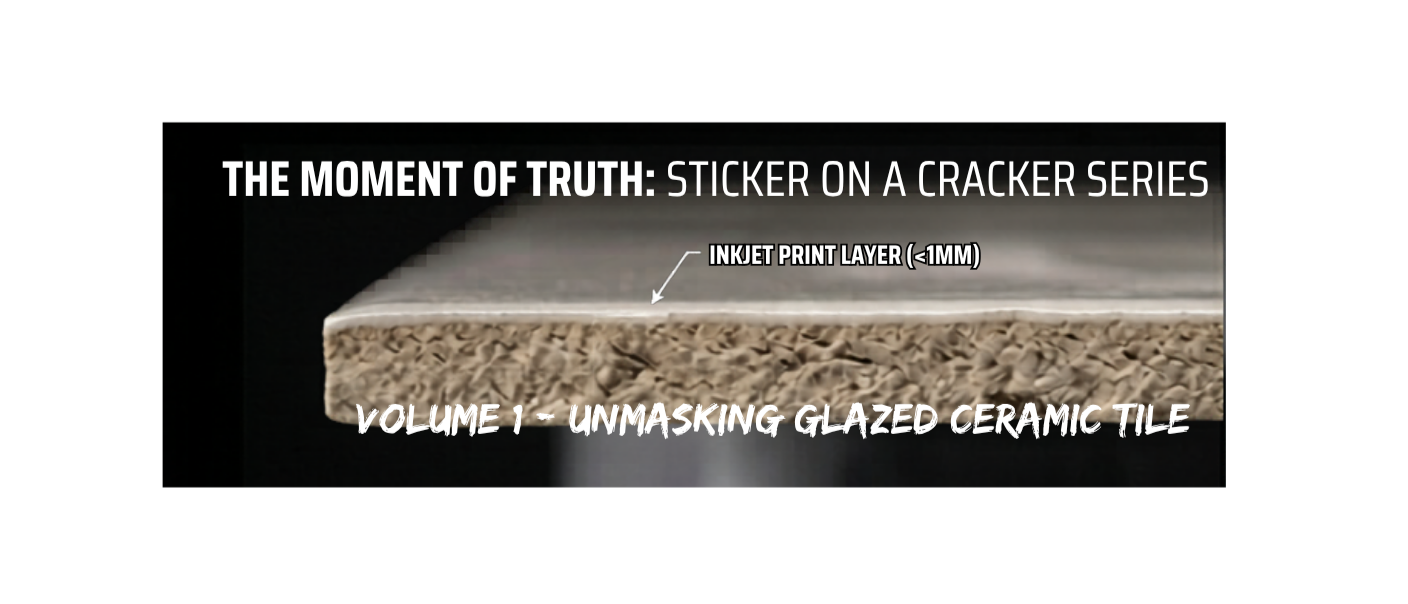
Sticker on a Cracker Series | Volume 1: Unmasking Glazed Ceramic
In the world of high-end design, the word "luxury" has been hollowed out by marketing departments. At The Material Realist, we don't look at the showroom lighting or the lifestyle photography; we look at the physics. Today, we are dissecting the industry’s most profitable deception: the Low-Density Glazed Ceramic Tile—or what we call the "Sticker on a Cracker".
In the world of high-end design, the word "luxury" has been hollowed out by marketing departments. At The Material Realist, we don't look at the showroom lighting or the lifestyle photography; we look at the physics. Today, we are dissecting the industry’s most profitable deception: the Low-Density Glazed Ceramic Tile—or what we call the "Sticker on a Cracker".
1. The Anatomy of a Fraud: The 1mm Veneer
Most "luxury" tiles found in big-box stores are not stone; they are high-definition lies. When you look at a cross-section of budget-grade ceramic, the "marble" or "travertine" beauty is only skin-deep—typically a 0.5mm to 1mm layer of inkjet-printed glaze sitting atop a thick, dusty core.
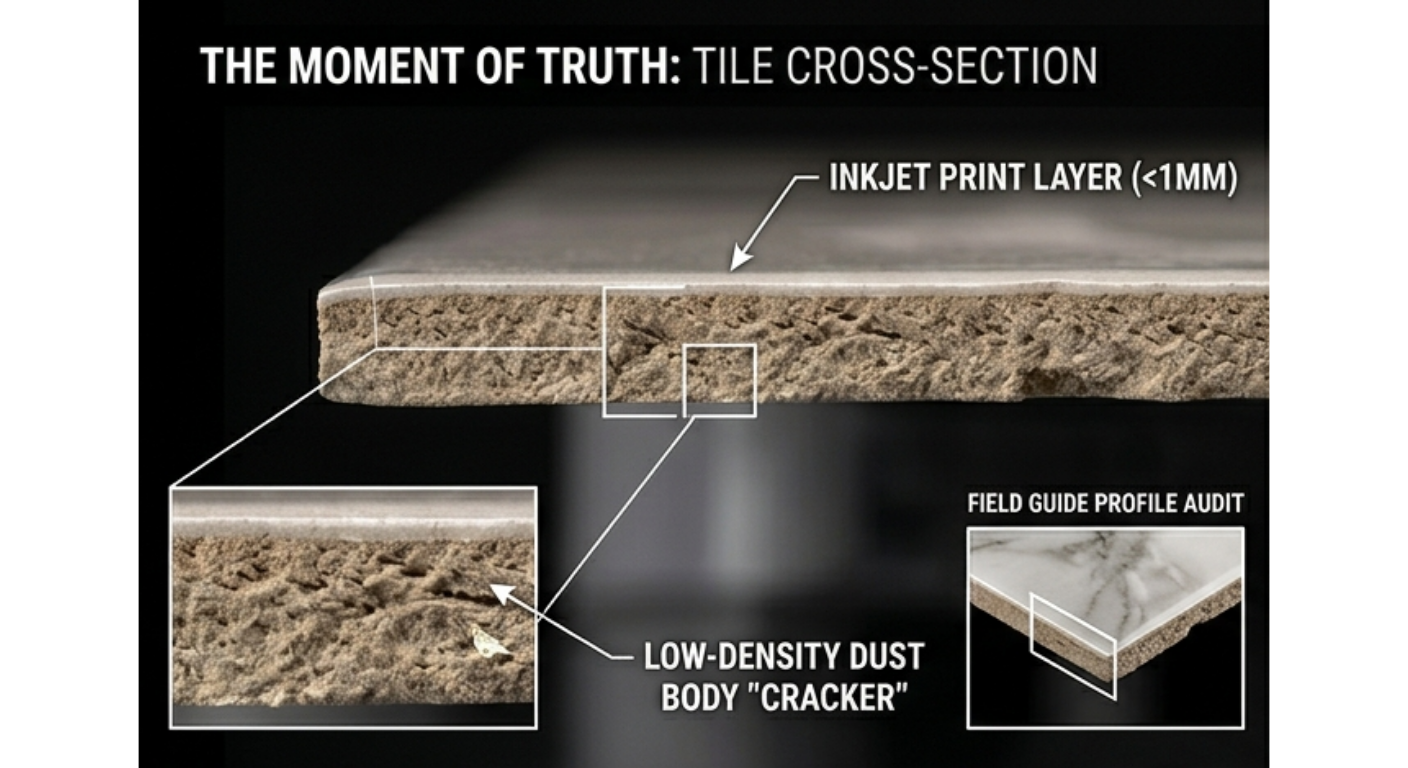
The Sticker: A digital file of real Italian marble is "inkjet" printed onto the surface.
The Cracker: The body is composed of low-density, porous clay—essentially a "biscuit" fired at temperatures below 1,000°C.
The Realist’s Rule: If the beauty of your floor can be scratched off with a screwdriver, it isn’t luxury. It’s a temporary decoration.
2. The Physics of Failure: Why It’s a "Financial Trap"
The difference between a "deal" and a "durable material" comes down to a scientific process called Vitrification. High-performance Italian porcelain is fired at over 1,200°C (2,200°F) until its molecules literally fuse into a non-porous, glass-like state.
Low-end glazed ceramic never reaches this state. This results in two critical failure points:
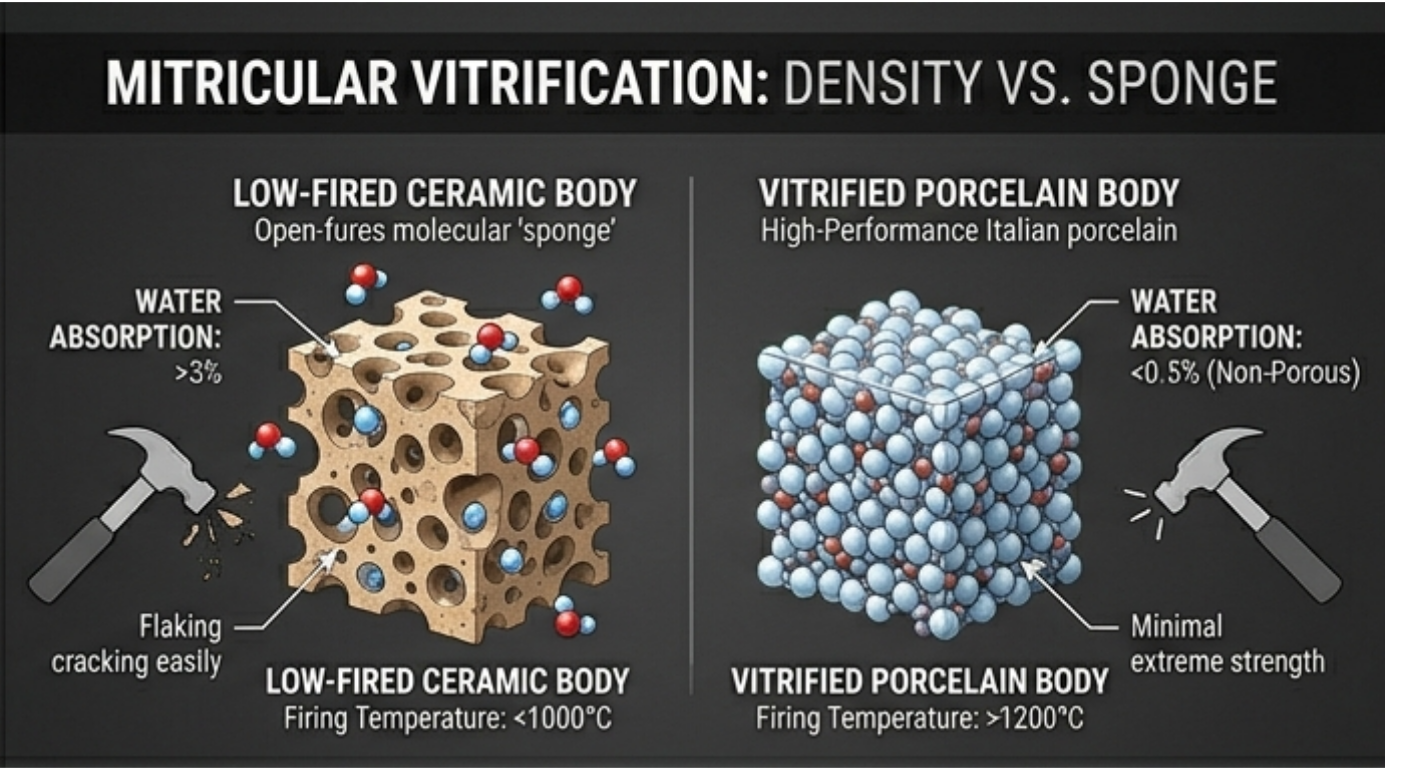
Molecular Porosity: Because the clay isn't vitrified, it remains a "sponge" with water absorption rates significantly greater than 0.5%.
Delamination: In a destruction test, when a heavy object hits the surface, the glaze doesn't just crack; it delaminates, flaking off the clay body and leaving a permanent, ugly scar.
Contrast this with a vitrified product, which is essentially a 100-year material with an abrasion resistance (PEI) rating that handles decades of high-traffic wear.
3. The Showroom "Glitch": Face Counts and Pixel Test
Real natural stone has infinite variation. Cheap tile has a "Face Count"—the number of unique digital files used before the pattern repeats.
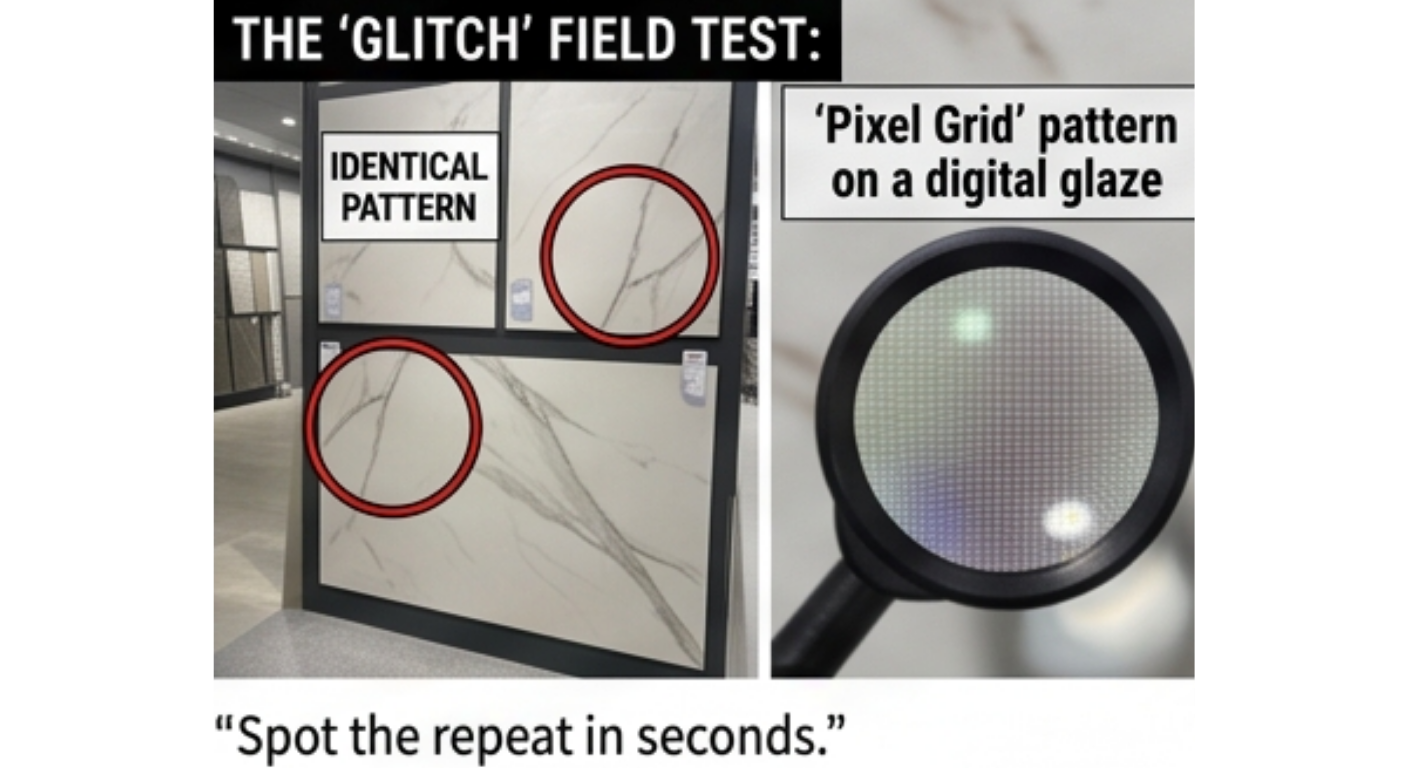
The Fake: Often only 1 to 4 faces. You will see the exact same "vein" or "crack" every three feet on your floor.
The Real: High-end engineering allows for 20 to 100+ unique faces, ensuring a natural entropy that mimics nature rather than a predictable photocopy.
The "Glitch" Test: Next time you’re in a showroom, don’t look at one tile. Look at the whole rack. If you see the same "swirl" twice, you’ve found the limit of the manufacturer's machinery.
The Realist’s Verdict
Buying "Sticker-on-a-Cracker" ceramic is a $10,000 mistake. While the material cost is low, the labor to install it remains the same. When that brittle clay shatters five years from now, you aren't just paying for new tile—you’re paying for the demolition and the re-installation of the truth you should have bought the first time.
Stop buying marketing. Start buying engineering.
Next Installment: The Sassuolo Monopoly: Why the Best Engineering is Concentrated in One Italian Region.
Register for free to download exclusive field guides and member only resources in The Vault.