The Scorch Factor & The Silica Crisis | Porcelain vs. Engineered Quartz, the Resin Reality, and the Material Global Ban
A forensic audit of the kitchen countertop industry's most profitable material workaround. This dossier unmasks the chemical composition of engineered quartz, details why its resin binders permanently melt and yellow under real-world conditions and breaks down the global occupational health crisis driving total national bans. Stop buying the showroom marketing. Read the raw engineering physics before you spec your next surface.
In the world of interior surfaces, marketing departments have pulled off a brilliant linguistic heist. They took a product made of crushed rock mixed with plastic binders, slapped the word "Quartz" on it, and convinced the public it was an indestructible, natural luxury evolution of natural stone.
At The Material Realist, we don’t buy showroom lighting or lifestyle brochures; we look at the composition.
Today, we are running a forensic audit on Engineered Quartz vs. Vitrified Porcelain Slabs. If you are about to drop $15,000 on kitchen countertops, you need to understand the physics—and the dark ethics—of the material before you sign the check.
The 30% Plastic Lie
Engineered quartz is not 100% stone. By volume, a typical quartz slab is roughly 85% to 93% mineral aggregates, but the remaining balance is a petroleum-based polyurethane or polyester resin binder.
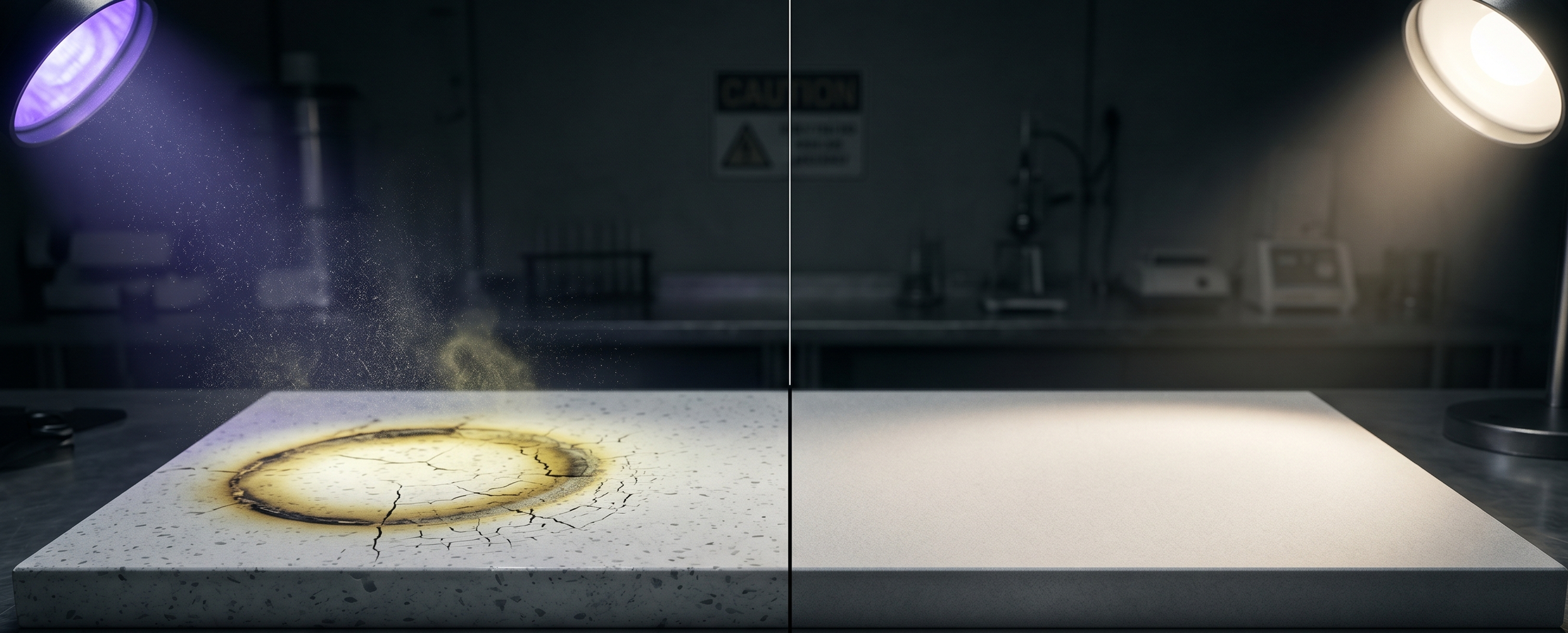
When a showroom rep tells you quartz is completely heat-resistant, they are ignoring basic chemistry. Minerals don’t melt on your countertop. Plastic does.
Porcelain, on the other hand, is a completely mineral-based product. Fired in industrial kilns at temperatures exceeding 1,200°C (2,190°F), its molecular state is entirely vitrified. It has already been through hell before it ever reaches your kitchen.
The Heat Factor (The Scorch Trap): Set a blistering hot cast-iron skillet directly onto a quartz surface, and you risk a permanent, yellowed ring. That isn't a stain; it’s the resin binder literally cooking and melting. Porcelain laughs at cast-iron pots because its mineral structure was chemically locked at temperatures four times hotter than your stove can ever reach.
The UV Reality (The Patio Fade): Thinking about quartz for an outdoor kitchen or a sun-drenched island? Don't. Polyurethane resins degrade under ultraviolet light. Constant exposure to the sun will turn a crisp, bright white quartz countertop into a dull, amber shade within a few seasons. True porcelain is entirely UV-stable—its color cannot fade because there are no organic binders to break down.
The Forensic Autopsy: The Silica Crisis & Global Bans
The flaws of engineered quartz extend far beyond a ruined finish in your kitchen. On the fabrication shop floor, this material has triggered an international health catastrophe.
While natural stone contains varying levels of silica, engineered quartz is an ultra-concentrated synthetic product composed of up to 90%+ crystalline silica agglomerated with resins and polymers. When fabrication workers cut, rout, and polish quartz slabs dry, it generates a massive cloud of micro-fine Respirable Crystalline Silica (RCS) dust.
Because of the extreme density of synthetic quartz, this dust behaves as a "toxic cocktail"—combining the sharp, lung-shredding properties of silica with vaporized polymer resin particles. Standard safety measures like basic dust masks are proving tragically inadequate. When inhaled, these micro-particles bypass the body's natural defenses, scarring lung tissue and causing Accelerated Silicosis—an aggressive, incurable, and entirely fatal occupational lung disease.
This isn’t an exaggeration or a minor workplace hazard; it is a global regulatory crisis:
The Australian Ban: Following an alarming spike in fatal silicosis cases among young countertop fabricators, Australia made history by enacting a total national ban on the use, supply, and manufacture of engineered stone.
The Global Fallout: Severe disease clusters among countertop workers have been reported globally, including major outbreaks in the United States (prompting strict emergency regulatory crackdowns in states like California), Israel, Spain, and the United Kingdom.
⚠️ The Realist's Health Warning
True luxury shouldn't cost a fabrication worker their life. When you purchase high-silica engineered quartz, you are supporting a supply chain plagued by regulatory failures and severe occupational illness. True high-performance Italian porcelain relies on entirely different mineral blends and advanced vitrification physics, making it the progressive, ethical, and structurally superior surface choice for the next generation of architecture.
The Realist’s Verdict
Vitrified porcelain is the destination. It offers the thermal immunity of an industrial kiln, the UV permanence of an open desert, and the uncompromised safety of an inert mineral compound. But when your layout demands a high-performance workspace, the raw chemistry matters.
If you are investing $15,000 or more in heavy-duty surfaces, do not compromise on material composition. The molecular structure required to withstand blistering heat and solar radiation without melting, fading, or putting human lives at risk on the fabrication floor only exists in monolithic, kiln-fired materials. If you specify quartz in 2026, you are paying a luxury premium for a material with built-in failure points that is facing aggressive regulatory obsolescence worldwide.
Stop buying plastic workarounds. Start buying material truth.
Register for free to download exclusive field guides and member only resources in The Vault.
The Monolithic Era | Why Large Format is the Engineering Future
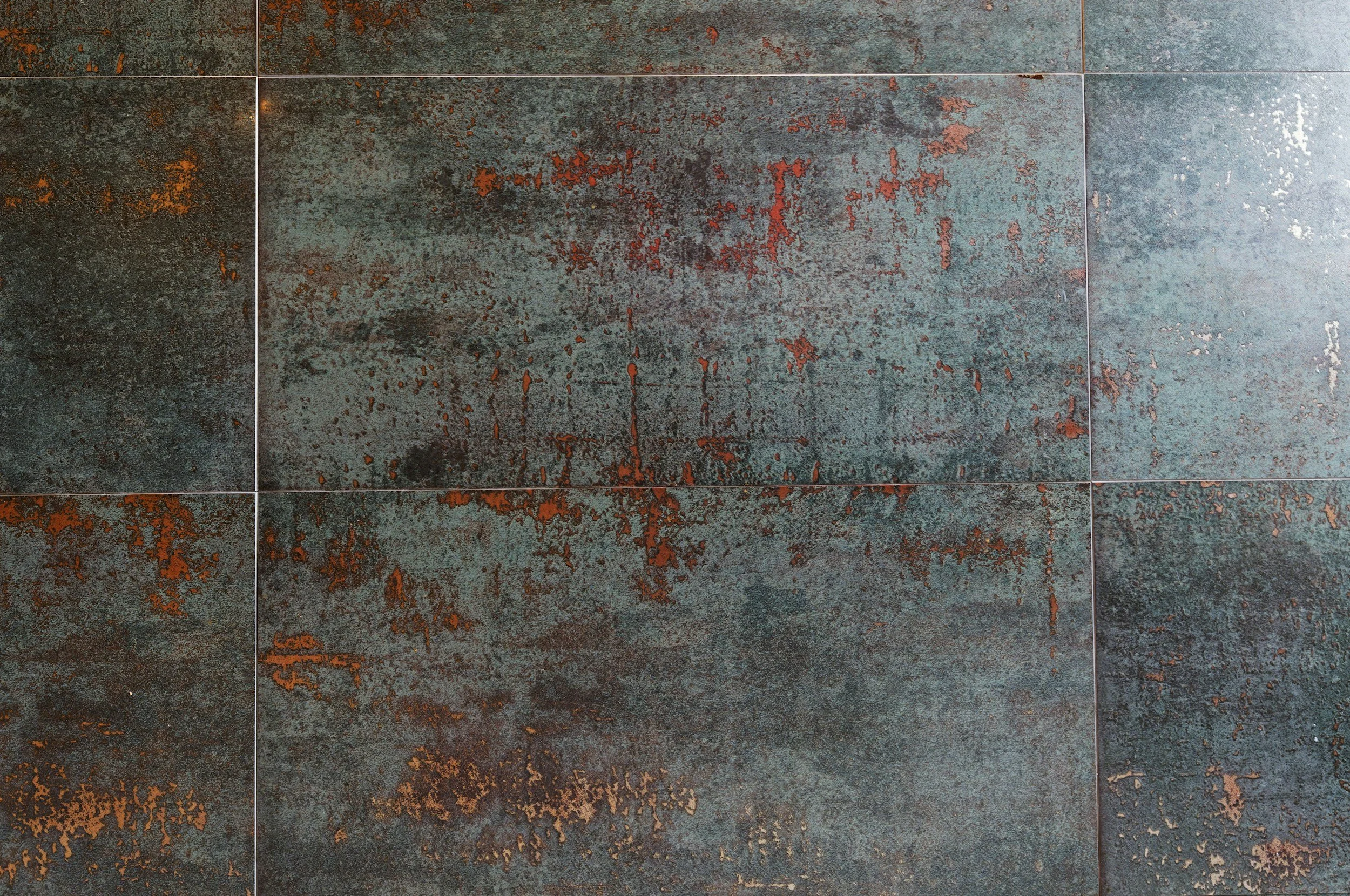
For decades, the "grid" defined the world of tile. Standard 24”x24” formats were the ceiling of material physics. But a revolution has occurred in the kilns of Sassuolo. We have entered The Monolithic Era. Large Format Porcelain (LFT)—specifically the 24”x48”, 48”x48”, and slabs—is no longer just a luxury aesthetic.
For decades, the "grid" defined the world of tile. Standard 24”x24” formats were the ceiling of material physics. But a revolution has occurred in the kilns of Sassuolo. We have entered The Monolithic Era.
Large Format Porcelain (LFT) — specifically the 24”x48”, 48”x48”, and slabs — is no longer just a luxury aesthetic. It is a superior engineering standard. Today, we analyze why the "Monolith" is the future of surfaces and how it solves the most expensive failures in residential construction.
The Grout-less Revolution: Eliminating the Weak Point
In any tile installation, the tile is the strongest component and the grout is the weakest. Grout is porous, prone to staining, and serves as a breeding ground for bacteria and mold.
By utilizing 48”x48” formats, you reduce the total linear feet of grout by up to 70% compared to traditional sizes.
The Outcome: A seamless, "infinite" aesthetic that remains biologically clean.
The Realist’s View: You aren't just buying a bigger tile; you are removing the primary failure point of your floor.
The Shower Lab: Combatting Water Damage with Physics
The most significant leap in Large Format utility is the use of Porcelain Slabs as wall panels. Traditional tiled showers have hundreds of grout joints—hundreds of opportunities for water to migrate behind the surface and rot the substrate.
The Non-Absorbent Shield: True Italian porcelain has a water absorption rate of <0.1%. It is essentially a glass-state shield.
Monolithic Walls: By using a single slab for a shower wall, you eliminate grout entirely from the splash zone.
The Result: A waterproof environment that is physically incapable of absorbing moisture, protecting the structural integrity of your home for decades.
The Sassuolo Standard: Breaking Strength & Planarity
Large format tile requires extreme engineering to stay flat. This is where True Italian Porcelain separates itself from "Fake Luxury."
Planarity (Flatness): To manufacture a 4th-generation 48"x48" tile that is perfectly flat requires the massive hydraulic presses found only in elite Italian facilities.
Bending Strength: Despite being thinner and larger, high-end LFT has a breaking strength exceeding 35 N/mm². It is designed to flex slightly with a building’s natural settlement without cracking, a feat cheap ceramic cannot achieve.
The Trap: Identifying "Fake Luxury" in Large Format
Because Large Format is high-margin, many low-quality factories are attempting to mimic the look. These "Fake Luxury" tiles carry three fatal flaws:
Planarity Deviation (The Bow): Cheap LFT often arrives "bowed" or warped. When installed, this creates Lippage (uneven edges) which leads to tripping hazards and edge chipping.
Internal Tension: If the cooling process in the kiln isn't perfect, the tile holds internal stress. As soon as a contractor tries to cut it for a socket or a drain, the entire slab shatters.
The Digital Blur: On a massive 48"x48" canvas, low-resolution printing becomes obvious. You’ll see "pixel noise" and blurred veins, destroying the illusion of natural stone.
The Realist’s Verdict
Large Format is the destination. It offers the hygiene of a laboratory, the waterproofing of a submarine, and the beauty of a mountain. But the bigger the canvas, the more the engineering matters.
If you are moving to 48”x48” or larger, do not compromise on origin. The physics required to maintain a monolith only exists in the world’s most advanced labs.
Stop building grids. Start building monoliths.
Register for free to download exclusive field guides and member only resources in The Vault.
The Friction Factor | Deciphering "Non-Slip" Claims
THE FRICTION FACTOR: Deciphering "Non-Slip" Claims
In the world of interior design, "luxury" often implies a polished surface. But for The Material Realist, beauty is irrelevant if the material is a liability. Showrooms and marketing departments frequently use generic, unregulated labels like "non-slip" or "matte finish" to describe wet-area viability.
These labels are a scientific lie. Physics doesn't use marketing adjectives; physics uses data. Today, we unmask the hidden measurement that defines safety and expose why buying a tile without a specific DCOF rating is a professional and financial liability trap.
The Teardown: Marketing vs. Physics
A marketing brochure will call a tile "safe for bathrooms." If you read the technical spec sheet (the data we analyze in "The Lab"), that same tile is often listed as "Polished Finish," which is inherently slick when wet.
Marketing Story: "Polished marble lookup for a seamless, spa-like wet room."
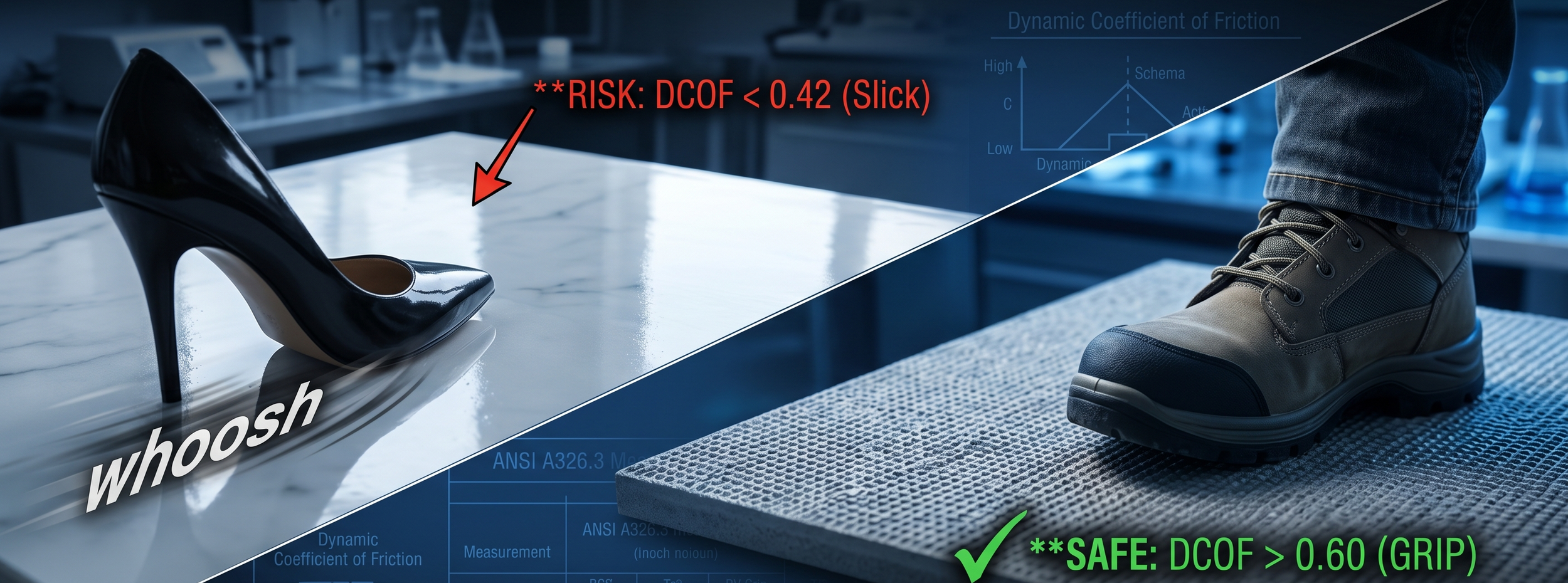
Engineering Reality: A high-gloss polished porcelain surface creates hydroplaning—a thin layer of water acts as a lubricant, reducing friction to nearly zero. This surface is a "slick" that violates global safety standards.
The Realist’s Rule: "Matte" and "Polished" are aesthetic descriptions. They tell you zero about performance.
Decoding the Data: What is DCOF?
Industry standards are silent on marketing terms, but they are explicit on a single measurement: the Dynamic Coefficient of Friction (DCOF).
Using test methods verified by the TCNA and ANSI standards (ANSI A326.3), DCOF measures how much friction is present while a subject is already in motion. This is the critical number.
DCOF < 0.42: Slick. Restricted use. Only acceptable for dry interior areas where traction is not a primary concern (living rooms, bedrooms).
DCOF > 0.42 (The Benchmark): This is the minimum industry requirement (ANSI standard) for wet interior environments. It includes commercial bathroom floors and main residential bathrooms.
DCOF > 0.60 (Grip/Exterior): This high-traction standard is required for exterior commercial ramps, pool decks, and public walkways. (This data is found in Unicom Starker’s "Structured/Grip" or "R11" finishes and 2thick paver lines).
The Liability Trap: Who Pays for the Fall?
When a tenant slips on a wet polished floor in a new luxury lobby, they do not sue the landlord. They sue the architect who specified the material and the developer who approved it.
If you specify a polished tile for a wet lobby area without verifying that the DCOF meets the 0.42 benchmark, you have specified a structural liability failure. The generic "non-slip" label on the brochure will provide zero legal defense in a slip-and-fall lawsuit. Physics is non-negotiable.
The Realist’s Verdict
Don't trust the adjective. Trust the coefficient.
When specifying materials for any wet environment—commercial bathroom, exterior patio, or high-traffic lobby—ignore the aesthetic descriptor. Demand the Technical Data Sheet (TDS) and look for the DCOF rating verified by a certified laboratory (like the Italian Sassuolo labs used by Unicom Starker).
If the physics isn't specified, the safety isn't guaranteed.
Register for free to download exclusive field guides and member only resources in The Vault.